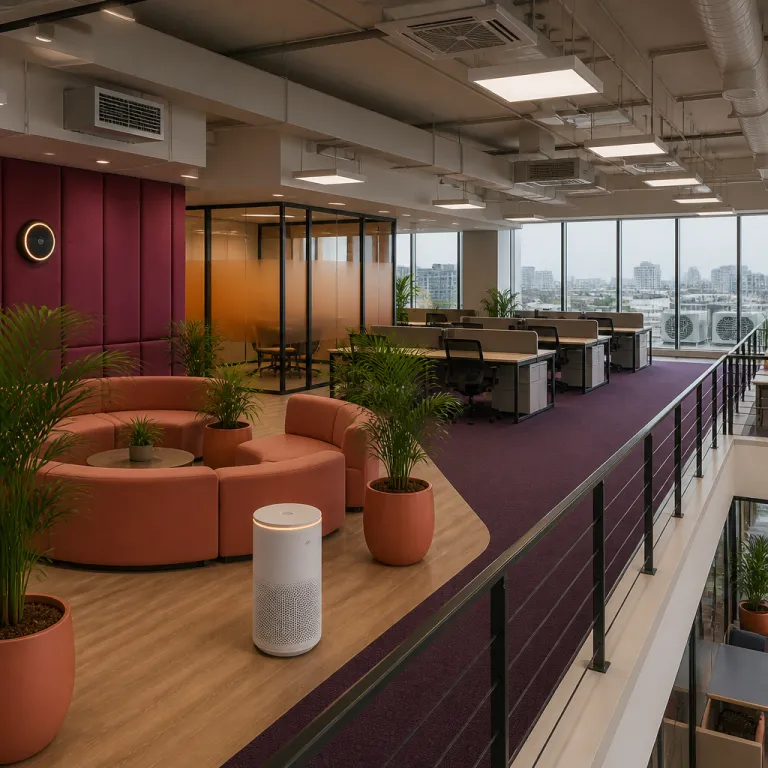
Why indoor air quality is now a core office metric in India
Most Indian workplaces still treat indoor air as a background utility. In metros where outdoor ambient air regularly crosses an AQI of 150, the indoor environments inside your building quietly decide whether your équipe delivers its best work or runs at a 10 to 15 percent productivity discount. For any quality office above 1 000 square metres, indoor air quality in Indian offices is now as material as rent, power and attrition.
When you walk a floor in Bengaluru, Gurugram or Hyderabad, you see polished cleaning routines and smart access systems. What you rarely see is any visible indoor air quality monitoring, any multi-parameter air quality monitors on walls, or even a simple CO2 display that tells you whether the ventilation systems are keeping up with occupancy. Yet the same office will have detailed data on pantry consumption and cab usage, while ignoring air quality and its direct link to health, cognitive performance and sick leave.
Think of indoor air as an invisible infrastructure layer. If your building lets in outdoor air pollution without adequate filtration, every meeting room becomes a slow leak on attention spans and decision quality. In India, where many Grade A buildings run sealed façades and central HVAC systems, the difference between clean air and stale air is not the city you are in, but how seriously your office management treats workplace air quality as an operational KPI.
The business case: health, talent and environmental compliance
For a GCC or large enterprise, the health impact of poor indoor air is not abstract. Multiple peer-reviewed studies, including work by Harvard T.H. Chan School of Public Health on “sick building” effects, link higher CO2, PM2.5 and volatile organic compounds to more headaches, slower response times and roughly 2 to 3 extra sick days per employee per year, which means indoor air quality in Indian workplaces directly shapes both payroll efficiency and retention. When outdoor ambient air is already compromised, the office becomes the only controlled building where you can guarantee clean air during working hours.
Talent markets in India have shifted faster than most facilities playbooks. Your HR team negotiates salary, hybrid flexibility and brand identity, while your environmental and workplace design choices quietly decide whether people feel energised or drained by 16:00. Linking indoor air, environmental design and brand positioning is not soft messaging; it is a concrete way to show that your organisation treats health, safety and sustainability as one integrated quality system rather than three disconnected compliance checklists, and this is where a focus on office air quality in India can differentiate you from other employers in the same micro market.
Regulators are also moving. National Building Code provisions on ventilation rates (for example Part 8, Section 3 on indoor environmental quality), Energy Conservation Building Code guidelines and emerging indoor air quality standards from bodies such as the Central Pollution Control Board are nudging offices toward better ventilation, filtration and quality monitoring. If you already track waste segregation and environmental compliance, you can extend the same discipline to air quality by aligning your office services, HVAC systems and cleaning contracts with measurable indoor air targets, using the same seriousness you apply to statutory registers and safety audits. Citing the relevant NBC and CPCB clauses in internal policies further anchors these targets in recognised Indian standards.
What to measure: from CO2 and PM2.5 to low VOC reality
Most office managers in India know their carpet area and power load, but not their CO2 baseline. A practical indoor air quality framework for Indian offices starts with four core metrics: CO2 ideally below 1 000 ppm in line with international best practice, PM2.5 under 35 micrograms per cubic metre (close to the 24-hour WHO guideline of 25 µg/m³ and more stringent than many local norms), temperature between 23 and 26 degrees Celsius and relative humidity between 40 and 60 percent. These numbers translate directly into how your people feel in meeting rooms, open bays and collaboration zones.
CO2 is your proxy for ventilation adequacy and crowding. When CO2 crosses 1 200 ppm in a closed meeting room, you can expect drowsiness, slower thinking and more complaints about “heavy air”, which is why indoor air quality monitoring that includes real time CO2 data is non negotiable for high utilisation floors. PM2.5 and other fine pollutants tell you whether your building systems are keeping outdoor air pollution out, while analytical testing for volatile organic compounds from new furniture, carpets and paints helps you verify whether your procurement choices are truly low VOC or just labelled that way in vendor brochures. Research from occupational health and building science journals consistently shows that low VOC environments correlate with better cognitive scores and fewer irritation complaints.
To operationalise this, you need a mix of continuous quality monitoring and periodic quality testing. Devices from vendors such as Kaiterra, Awair and AirVisual can act as floor level quality monitors for CO2, PM2.5 and temperature, while an accredited testing laboratory such as SGS, UL or TUV SÜD can provide formal testing services for VOCs, ozone and other pollutants through scheduled analytical testing. Over time, you build a data set that links indoor air, occupancy patterns, cleaning chemicals and HVAC operation, turning a vague wellness narrative into hard numbers that your CFO and global real estate team can understand. A simple internal infographic or table that summarises these KPI targets by floor, with colour bands for “within range”, “watch” and “action needed”, makes this data easy to scan in monthly reviews.
Low cost monitoring and HVAC interventions that actually work
Office managers often assume that serious indoor air quality tracking requires a full building management system overhaul. In reality, you can start improving indoor air quality in Indian corporate spaces with a handful of strategically placed quality monitors costing between 8 000 and 25 000 rupees per unit, one per floor or per 500 square metres depending on layout. These devices give you real time data on CO2, PM2.5, temperature and humidity, which is enough to identify hotspots and timing issues in your ventilation schedule.
Once you see the data, HVAC conversations with your IFM partner become sharper. Instead of generic complaints about “stuffy air”, you can point to specific meeting rooms where CO2 spikes above 1 500 ppm after 30 minutes, or open bays where PM2.5 rises whenever the fresh air dampers modulate down, and then you can calibrate ventilation systems, adjust outside air ratios and tune supply air temperatures with clear targets. Upgrading to MERV 13 or equivalent filters, checking duct cleaning frequency and ensuring that air handling units run long enough before occupancy can significantly reduce indoor pollutants without major capex.
Cleaning practices also matter more than most vendors admit. If your housekeeping services use strong fragrances or high VOC chemicals during working hours, your indoor environments will show VOC spikes on any decent testing lab report, and employees will feel it as irritation or mild nausea. Shifting to low VOC cleaning products, scheduling deep cleaning and duct cleaning during off hours and aligning your cleaning scope with indoor air quality standards turns a routine contract into a lever for both health and environmental performance, especially in dense Indian office buildings where windows do not open. One Bengaluru technology floor that installed three monitors across 2 000 square metres saw average CO2 drop from 1 200 ppm to under 900 ppm and PM2.5 fall by nearly 40 percent within a quarter, simply by extending AHU run time, upgrading filters and switching to low VOC cleaning agents.
Turning IAQ into a quarterly KPI and vendor brief
The real shift happens when indoor air quality in Indian offices moves from a one time project to a standing KPI. Start by adding a simple indoor air quality dashboard to your monthly facilities review, with CO2, PM2.5, temperature and humidity trends for each floor, and then link these trends to absenteeism, helpdesk tickets and employee feedback. Over two or three quarters, you will see patterns that let you argue for specific investments in ventilation, filtration or layout changes with hard evidence.
Vendor management should follow the same logic. Your IFM, HVAC and cleaning services contracts can include explicit indoor air quality standards, such as maximum CO2 levels in occupied zones, target PM2.5 levels for indoor air during working hours and requirements for low VOC materials in any refurbishment, and you can back these clauses with periodic quality testing by an accredited testing laboratory to keep everyone honest. When you negotiate renewals, ask for testing services and analytical testing reports as standard deliverables, not as optional extras buried in annexures. A sample quarterly dashboard might show average CO2 by zone, percentage of time within PM2.5 limits, filter replacement dates and any non-compliance events, giving vendors and internal teams a shared, visual scorecard.
Finally, communicate selectively but clearly with employees. You do not need to publish every data point, but sharing that your building meets defined air quality standards, that you run regular testing laboratory audits and that you act on quality monitoring insights sends a strong signal about your environmental and health priorities. In a market where talent has options, the quiet promise of clean air, fewer sick days and a thoughtfully managed indoor environment can be the edge that keeps your best people from taking the next recruiter call.
FAQ
What are the minimum indoor air parameters an Indian office should track ?
At a minimum, an Indian office should track CO2, PM2.5, temperature and relative humidity across all occupied zones. CO2 should generally stay below 1 000 ppm, PM2.5 below 35 micrograms per cubic metre, temperature between 23 and 26 degrees Celsius and relative humidity between 40 and 60 percent. These parameters reflect a blend of WHO guidance and common Indian practice, and they give a practical view of ventilation effectiveness, filtration performance and basic thermal comfort in typical Indian office buildings.
How often should indoor air quality testing be done in a corporate office ?
Continuous monitoring through fixed quality monitors should run every day during working hours, with data logged for trend analysis. Formal indoor air quality testing by an accredited testing laboratory is usually done once or twice a year, or after major fit outs, HVAC changes or complaints about odours and discomfort. High risk locations such as basements, printing rooms and cafeterias may need more frequent analytical testing depending on usage and past results.
Do green rated buildings automatically have good indoor air quality ?
Green ratings such as IGBC or LEED often encourage better ventilation and material choices, but they do not guarantee consistently good indoor air quality in operation. Actual performance depends on how the HVAC systems are run, how filters and ducts are maintained and whether low VOC materials and cleaning products are used over the life of the building. Even in certified buildings, office managers should run independent indoor air quality monitoring and periodic quality testing to verify conditions on each floor.
What low cost steps can improve indoor air quality without major capex ?
Several operational changes can improve indoor air without large investments. These include extending HVAC run time before and after occupancy, upgrading filters within existing units, ensuring regular duct cleaning, switching to low VOC cleaning chemicals and controlling indoor sources of pollutants such as smoking or strong solvents. Adding a few strategically placed quality monitors also helps you fine tune ventilation schedules and cleaning routines based on real time data.
How can indoor air quality be linked to employee wellness programmes ?
Indoor air quality can be integrated into wellness programmes by treating it as a foundational health parameter, similar to ergonomic seating or lighting. Offices can share periodic summaries of air quality data, explain how ventilation and filtration protect employees from outdoor air pollution and invite feedback on comfort and odours. When employees see that management tracks and improves indoor air alongside other wellness initiatives, trust in the overall programme usually increases.