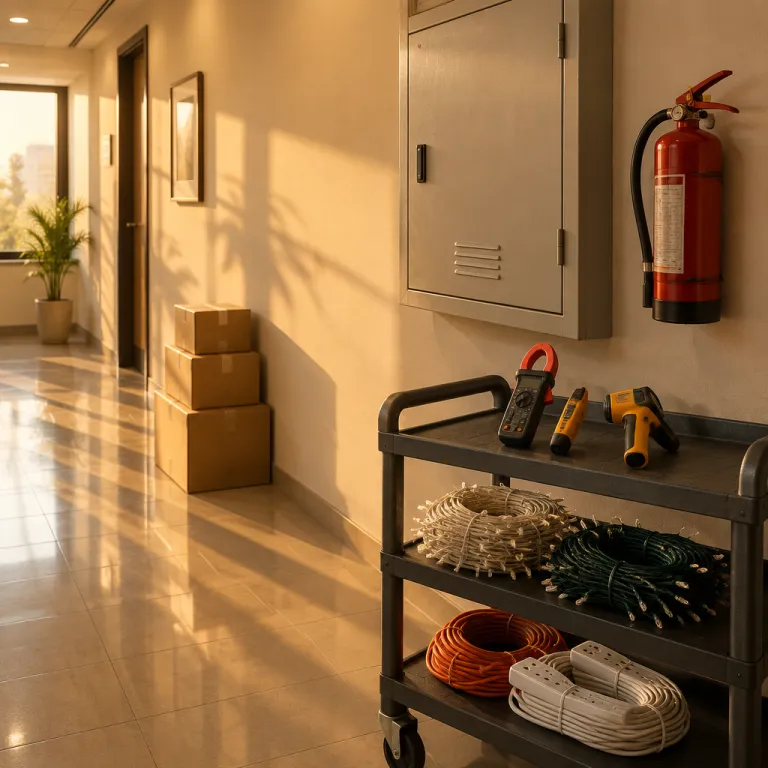
Why Diwali office fire safety in India starts with your electrical load sheet
Diwali office fire safety in India is not about fear, it is about control. When the festive mood peaks in late October, most Indian offices quietly double their electrical load with decorative lights, extra plug points and temporary displays that can catch fire without warning. The admin head who treats this as a structured pre-festival audit, not a last-minute décor approval, will prevent fire incidents before they ever reach the fire brigade.
Start with your load schedule and panel boards, then check which circuits already run close to capacity before any Diwali lights or diyas candles are added. As a thumb rule, avoid loading any final circuit beyond 80% of its MCB rating (for example, keep a 16 A lighting circuit under about 12–13 A, and a 20 A power circuit under 16 A). In many Delhi and Delhi NCR offices, decorative lights, extra laptops and pantry equipment all land on the same ring main, so one loose wire can turn a minor spark into a full Diwali fire that races through paper cloth partitions and stored files. Ask your building services team or external electrical services vendor to check thermal imaging, breaker ratings and cable insulation, and insist they document every risk in writing so you can call out non-compliance with authority.
During the festive period, do not allow housekeeping to daisy-chain extension boards just to keep everyone happy with more lights. Make a simple rule that any new string of decorative lights or any extra plug point must be approved by facilities, who will check the nearest panel, the breaker size and the route of the wire before they keep it switched on. For example, they should confirm that a 6 A multi-plug is not feeding a 15 A heater or kettle, and that flexible cords are not running under carpets where they can overheat. This is where Diwali office fire safety in India becomes a business KPI, because one tripped panel during a client call can cost more than a full year of safety equipment upgrades.
Many office managers in Delhi NCR still assume that because fire safety and electrical clearances were obtained at fit-out, they are covered for every festive overload. That assumption fails the moment someone tapes wires over a false ceiling, or lets diyas candles burn near low-hanging fabric where clothes catch and paper cloth décor can ignite in seconds. Treat every new decorative element as a potential source of fire incidents, and make your team log where it is placed, which circuit it uses and who will check it daily during the festive week.
Crackers and firecrackers are usually banned inside office campuses, but Diwali office fire safety in India still has to account for employees who light green crackers in parking areas or on terraces. Even when only certified green crackers are allowed in Delhi or allowed in Delhi NCR by local orders, sparks can travel through open windows and catch fire on curtains, cardboard boxes or cloth backdrops. Issue a clear mail that any crackers or firecrackers used near the building must be coordinated with security, who will keep water buckets and a fire extinguisher ready at the nearest exits.
When you frame this as a compliance and continuity issue, your CFO listens differently. You are not just talking about safety tips or generic safety fire messages, you are talking about avoiding burns, asset loss and downtime that can derail quarter-end closings. For a deeper view on how to frame such operational risks as structured business challenges, study the approach in this guide on building a rigorous business challenge identification process for Indian office managers, then adapt the same rigor to Diwali electrical and fire-load planning.
Sample Diwali electrical load snapshot (illustrative)
Use a simple table like this to visualise festive loads on each circuit before approving décor:
| Circuit / Panel | MCB rating (A) | Normal load (kW) | Proposed Diwali load (kW) | Total (kW) | % of capacity* |
|---|---|---|---|---|---|
| Lighting Circuit L-03 (3rd floor) | 16 A | 2.2 | 0.6 (decorative lights) | 2.8 | ~80% |
| Power Circuit P-02 (workstations) | 20 A | 3.0 | 0.8 (extra laptops) | 3.8 | ~83% |
| Pantry Circuit PN-01 | 32 A | 5.0 | 0.5 (additional warmers) | 5.5 | ~79% |
*Assuming 230 V single-phase; aim to keep circuits below roughly 80% of rated current during Diwali.
Extinguishers, exits and emergency roles: the Diwali-ready fire safety drill
Once the electrical side is under control, Diwali office fire safety in India shifts to people, equipment and practice. A beautifully maintained panel means little if your team does not know which fire extinguisher to use, where the exits are or whom to call when a small flame starts to catch fire near decorations. The office manager’s job is to turn these into muscle memory before the festive rush, not during an emergency when panic and smoke already cloud judgment.
Walk every floor with your security supervisor and physically check each fire extinguisher, then log the pressure gauge, expiry date and access path. In many mid-size offices, fire extinguishers are technically present but blocked by cartons, plants or festive props, which makes them useless when a Diwali fire jumps from diyas to curtains or from decorative lights to a nearby workstation. Use this walk to confirm that exits are not narrowed by rangoli, standees or shoe racks, and that every emergency door actually opens freely without a key.
During October, run a short, focused drill that is explicitly framed around Diwali office fire safety in India rather than a generic annual exercise. Keep it practical by simulating a small fire near diyas candles in the reception or a spark from decorative lights in the cafeteria, then ask volunteers to use the nearest fire extinguisher while others guide colleagues to the exits. This is also the moment to remind everyone that they must call fire services or the fire brigade immediately if they cannot control the situation within seconds, and that they should never try to be heroes when burns and smoke already threaten their safety.
Assign clear emergency roles for the festive week, because many regular leaders may be on leave. Nominate one person per bay to keep water handy in buckets or bottles near high-risk décor, one to check that all lights and diyas are extinguished before leaving, and one to call fire services if anything escalates beyond a small controllable flame. Document these roles in a simple one-page emergency plan and share it with your leadership, linking it to your broader business continuity thinking rather than treating it as a one-off Diwali memo.
Housekeeping and security vendors often promise full safety services, but you know the reality on the ground. Guards rotate, housekeeping staff change, and unless you personally check their training on fire safety equipment and basic safety tips, Diwali office fire safety in India will remain a PowerPoint topic instead of a lived practice. Use your vendor review meetings to insist on proof of training, mock drills and clear escalation matrices, and do not hesitate to push back when a vendor tries to cut corners on fire safety to save a few rupees.
There is also a compliance angle that office managers sometimes underplay. While the National Building Code and local fire department norms set the baseline, your internal risk appetite and insurance conditions often demand higher standards, especially in dense Delhi NCR business districts. When you negotiate with landlords or co-working operators, ask pointed questions about their last fire brigade inspection, their emergency call protocols and how they manage Diwali-specific risks like diyas, crackers and temporary stalls in common areas.
Housekeeping, décor and night-time shutdown: controlling the hidden Diwali fire load
The most visible part of Diwali office fire safety in India is décor, yet it is usually the least controlled. Housekeeping teams love to improvise with cloth backdrops, paper cloth streamers and extra lights, which look great on social media but can catch fire in seconds if a diya tips or a wire overheats. Your role is not to kill the festive mood, it is to set non-negotiable boundaries that keep celebrations safe and compliant.
Issue a simple décor policy that bans open diyas and diyas candles near curtains, upholstery, paper cloth art or low ceilings, and that limits them to metal trays placed on stone or metal surfaces. Make it explicit that only LED decorative lights with proper plugs are allowed, and that no one may tape bare wires or multi-plugs onto carpets, partitions or false ceilings where a hidden Diwali fire can smoulder unnoticed. Ask housekeeping to keep water buckets and a small fire extinguisher near any cluster of diyas, and to check every hour that wicks are stable and that no oil has spilled onto the floor.
Night-time is when most Diwali office fire safety in India actually fails, because lights are left on and no one is around to respond. Put a strict rule that all decorative lights must be switched off before the last person leaves, and that only essential emergency lights and safety equipment remain powered. Security should do a final walk-through to check for any live diyas, any smell of burning plastic near decorative lights and any blocked exits, then log this in a simple register that you review after the festive week.
Many office managers in Delhi and other metros underestimate how quickly clothes catch fire when employees wear flowing ethnic outfits near diyas or incense. Brief your teams that they should keep a safe distance from open flames, avoid trailing dupattas near diyas candles and never lean over rangoli where hidden diyas might sit under decorative lights. Keep water and a small fire extinguisher near photo zones and stages, because these are the spots where people crowd, pose and forget basic safety tips in the excitement.
Parking areas and terraces are another blind spot for Diwali office fire safety in India. Even when only certified green crackers are allowed in Delhi or in gated corporate parks, sparks can land on parked vehicles, dry leaves or discarded paper cloth, leading to sudden fire incidents that escalate before anyone can call fire services. Coordinate with your landlord or facility manager to define clear zones where crackers or green crackers, if allowed, may be used under supervision, with keep water buckets, sand and fire extinguishers placed within arm’s reach.
This is also the right moment to align your Diwali plan with your broader continuity thinking. A small fire in the server room or DG area during the festive break can cripple operations for days, which is why your Diwali office fire safety in India checklist should plug directly into a broader business continuity plan. If you have not yet formalised that plan, use this template on the business continuity plan most Indian offices do not have as a starting point, then add Diwali-specific scenarios like electrical overloads, decorative fires and reduced staffing.
Festive staffing, landlord coordination and the Diwali emergency playbook
By the time Diwali week starts, your biggest risk is not just fire, it is thin staffing. Diwali office fire safety in India becomes fragile when only a skeleton crew is on-site, many of them temporary guards or housekeeping staff who do not know the building’s emergency routes. The office manager who plans a lean but capable emergency roster for the festive period will sleep better than the one who simply hopes nothing will catch fire.
Build a mini-duty roster that covers every shift from late October through the main festive days, ensuring at least one person on-site knows how to use a fire extinguisher and how to call fire services or the fire brigade. Share a laminated emergency card at every security post with key numbers to call fire services, building control rooms and internal leaders, and include simple safety tips on handling burns, smoke and small electrical fires. Make it clear that in any suspected Diwali fire, the first action is to raise an alarm and call fire services, not to film the incident on phones.
Landlord coordination is non-negotiable for Diwali office fire safety in India, especially in multi-tenant towers across Delhi NCR and other dense business hubs. Ask for a pre-festive meeting with the building management to check their own fire safety equipment, their emergency generator capacity and their rules on crackers, green crackers and decorative lights in common areas. Use that meeting to clarify who will call fire services in different scenarios, how quickly the fire brigade can access basements and terraces, and how information will flow between tenants during any emergency.
Document everything in a short Diwali emergency playbook that sits alongside your regular risk manuals. This playbook should list the location of all fire extinguishers and exits, the process to keep water and sand ready near high-risk zones, and the exact steps to take when clothes catch fire or when someone suffers minor burns from diyas or crackers. Share it with your leadership and admin peers, and reference frameworks like those discussed in this analysis of what new employment rules mean for Indian office managers to reinforce that safety is as much a people and policy issue as it is a technical one.
Finally, treat Diwali office fire safety in India as a recurring annual project, not a one-time checklist. After the festive week, run a short debrief with your équipe, security and housekeeping to capture what worked, where safety equipment failed and how quickly any emergency call was handled. The real ROI of this work is not the number of fire extinguishers you bought, but the number of fire incidents that never happened and the hours of productive work you quietly protected.
One-page Diwali office fire safety checklist (printable summary)
- Electrical and load sheet
- Update panel-wise load schedule; keep each circuit under roughly 80% of MCB rating.
- Ban daisy-chained extension boards and overloaded multi-plugs.
- Use only LED decorative lights with intact plugs and cables.
- Décor and open flames
- Allow diyas only on metal/stone trays, away from curtains and paper cloth décor.
- Keep water buckets and at least one small extinguisher near every diya cluster.
- Switch off all decorative lights before the last person leaves.
- Equipment and drills
- Check extinguisher pressure, expiry and access on every floor.
- Run a short Diwali-focused evacuation and extinguisher drill.
- Ensure exits, staircases and emergency doors are fully clear.
- Staffing and coordination
- Prepare a festive duty roster with at least one trained person per shift.
- Share emergency numbers at all security posts and reception desks.
- Align rules on crackers and common-area décor with the landlord.
FAQ: practical questions office managers ask about Diwali office fire safety in India
What is the single most important Diwali fire safety step for an office?
The most critical step for Diwali office fire safety in India is a pre-festive electrical and décor audit. You need to check panels, circuits, decorative lights and all locations where diyas or diyas candles might be used, then remove or redesign anything that can easily catch fire. This one exercise eliminates many common fire incidents before they start.
Are diyas and candles safe to use inside office premises during Diwali?
Diyas and candles can be used safely only under strict controls. Place them on metal or stone trays away from curtains, paper cloth décor and high-traffic areas, and always keep water and a suitable fire extinguisher nearby. Never leave diyas candles unattended, and ensure security does a final check before locking the office.
How should offices handle crackers and green crackers during Diwali?
Most offices should prohibit crackers and firecrackers within the main building and near entrances. If certified green crackers are allowed in Delhi or in your park, restrict them to designated outdoor zones with sand, keep water buckets and fire extinguishers on standby, and coordinate closely with building security. Communicate these rules clearly so employees do not improvise unsafe celebrations.
What emergency equipment must be checked before the Diwali week?
Before the festive period, verify that all fire extinguishers are charged and accessible, that exits are clear and that emergency lights and alarms function properly. Also check that safety equipment like hose reels, sprinklers and manual call points are not blocked by decorations or storage. This ensures your office can respond quickly if any Diwali fire breaks out.
How can office managers train staff quickly on Diwali-specific fire risks?
A short, scenario-based drill works better than long classroom sessions. Run a 20-minute exercise showing how to use a fire extinguisher, how to call fire services and what to do if clothes catch fire or someone suffers minor burns from diyas or crackers. Focus on simple safety tips and clear roles so people remember what to do under pressure.